



Why OptiDraw Technology Makes Blood Tests Easier for Mothers & Kids

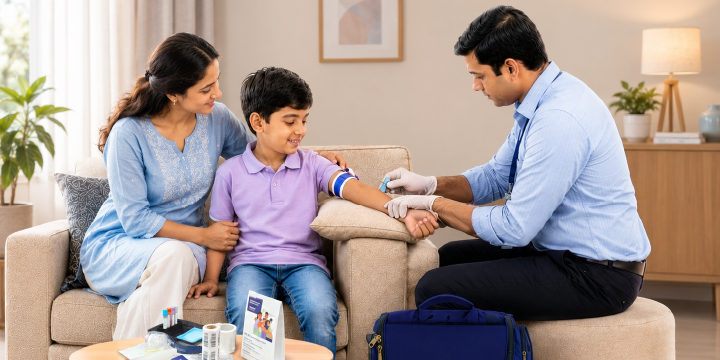
Table of Contents
You’re sitting in the diagnostic center, holding your daughter’s hand and tears in her eyes as the phlebotomist prepares the needle. Your own heart is racing but you fake a smile, squeeze her hand, and silently pray it goes smoothly this time.
If you’ve been in this situation, you already know that the getting a blood test for your child is not a simple task. The anxiety starts days before the appointment. The guilt lingers long after. And the helplessness you feel while watching your child cry and experience discomfort, can be overwhelming.
That’s why we’ve introduced OptiDraw technology, an advanced blood collection method that draws up to 50% less blood than conventional approaches while maintaining the same diagnostic accuracy. Wondering how OptiDraw can change the blood collection approach for kids? Let’s understand everything in detail.
Understanding Why Pediatric Blood Draw Techniques Matter
Modern pediatric blood draw techniques have evolved significantly over the years, but here’s something that might surprise you: the technical skill of the phlebotomist, while important, isn’t the only factor that determines whether your child’s blood draw goes smoothly. Research reveals that around 50% of children experience significant anxiety and fear of needles, which directly affects their ability to cooperate [1].
What matters even more than technique is something you have direct control over, your own emotional state. When you’re anxious, your child receives signals of fear and uncertainty, making it more difficult for them to cope with the procedure. This creates a feedback loop: your stress increases their anxiety, which makes them less cooperative, which increases your stress further, which they pick up on, and the cycle continues.
Why OptiDraw Technology Offers Real Relief for Worried Parents
Now let’s talk about how OptiDraw technology fits into this picture, not as a magic solution that eliminates all anxiety, but as one meaningful improvement that can make a real difference in your child’s experience.
OptiDraw technology uses precision vacuum system to collect only 2 ml of blood instead of the conventional 4-5 ml, reducing the physical burden on your child by up to 50%. For a child, this isn’t just a technical detail; it’s a significant reduction in the amount of blood their body needs to replenish.
When you choose OptiDraw technology for your child’s blood test, you’re choosing a method specifically designed to minimize discomfort and maximize success on the first attempt. It reduces not just the volume of blood taken, but the duration and intensity of the entire experience.
As this procedure is faster than the conventional draws, for an anxious child struggling to sit still, those saved seconds matter enormously. This is a difference between a child who cooperates calmly and one whose anxiety escalates beyond their ability to manage.
Moreover, OptiDraw pairs its reduced volume with a fine-gauge butterfly needle, built for smaller, more delicate paediatric veins. The smaller volume and gentler collection process mean your child’s arm is less likely to show the telltale purple marks that serve as a visible reminder of the experience. This matters not just cosmetically, but psychologically, when children don’t have a constant visual reminder of the procedure, they’re less likely to develop lasting anxiety about future blood tests.
There’s also less bruising and faster recovery. This makes it is a more considered fit than a standard needle sized primarily for adult use.
Remember, locating a viable vein remains a matter of clinical skill and individual anatomy. What OptiDraw changes is requiring smaller volume of blood as compared to conventional methods. And coupled with butterfly needle, this ensures gentler approach for the veins already prone to trauma.
In addition to children, OptiDraw is also beneficial for senior citizens, people with delicate veins and chronic conditions. Read more about OptiDraw and Chronic Testing: What It Means for Patients Who Test Often.
Maintaining Accuracy While Prioritizing Comfort
You might wonder whether less blood means less accurate results. It’s a reasonable concern, but here’s what you need to know. OptiDraw can test up to 67 parameters from a single 2 ml sample, covering everything most children need for routine diagnostic testing.
Every OptiDraw sample undergoes the same rigorous 3X quality checks as any other sample processed at Torrent Diagnostics’ state-of-the-art national reference lab. The precision vacuum technology actually improves accuracy by ensuring proper blood-to-additive ratios in collection tubes, something that can vary with manual collection methods.
More blood doesn’t mean better results. What matters is precise collection, proper handling, and rigorous quality control, all of which OptiDraw delivers while requiring about half the blood volume of conventional methods.
Preparing Your Child for a Blood Test
While OptiDraw can help with smarter blood collection for kids, preparing your child for testing can be quite tiresome. Here are few simple tips & tricks that can help deal with anxiety and ensure a smoother experience overall:
- Parents should manage their own stress levels first. A calm demeanour can help instil confidence in children.
- Schedule blood tests when your child is well-rested, not at the end of a long day when they’re tired.
- Similarly, ensure your child has eaten a nutritious meal before the appointment.
- Communicate openly with your children about what to expect during blood collection, using simple and reassuring language.
- If your child says they’re scared, acknowledge their fear as it helps to reduce the intensity of their anxiety.
Teach coping techniques like deep breathing or use distraction methods like bringing a favourite toy or playing a game on your phone.
Moving Forward with Confidence
Understanding the blood draw challenges your child faces, whether it’s small veins, needle fear, or past negative experiences, can help deal with the anxiety for future appointments. When you manage your own stress, communicate openly with your child, ensure they’re well-rested and nourished, and choose diagnostic services that prioritize gentle collection methods like OptiDraw, you create the best possible conditions for a positive experience.
Right from routine tests to specialised tests, OptiDraw can test up to 67 parameters with just 2 ml of blood. Book your test today with home sample collection to know the difference.
References
Rate the article

Comments